8:00am – 9:30am Breakfast
9:30am – 12:30pm Major Workshop
12:30pm – 1:30pm Lunch
1:30pm – 3:00pm Mini Workshop 1
3:00pm – 3:30pm Break
3:30 – 5:00pm Mini Workshop 2
5:00 – 5:15pm Directions for dinner (optional)
Major Workshops
Identifying Cultured Microbiome Bacteria with Oxford Nanopore Sequencing
Larry Blumer & Chris Beck
In this course-based undergraduate research experience, students extract microbiome bacteria from insects and culture bacteria on tryptic soy agar plates or other media. Students pick individual bacterial colonies to make a suspension of each colony and use that suspension to perform PCR on 16S rDNA. A unique barcode DNA sequence is attached to the PCR products in each sample in a separate rapid reaction. Subsequent pooling of as many as 24 barcoded samples permits sequencing the DNA with an Oxford Nanopore sequencer for the purpose of identifying gut microbiome bacteria. The instructor (teaching assistant or laboratory technician) uses the pooled barcoded samples to complete the DNA Library preparation and loads a DNA sequencing flow cell (Oxford Nanopore MinION flow cell) to start the sequencing process. A folder of FASTQ files of the DNA sequence data will be created for each sample in a sequencing run that the instructor then must process with free web-based software (EPI2ME software) to determine the consensus sequence for each sample. The resulting consensus FASTQ files are then converted to FASTA files for BLAST analysis by students.
Whatsits in winter: A Branched Options Exercise for Illustrating Natural Selection
Dan Johnson
This workshop is designed for instructors and lab coordinators who are: looking for an adaptable outdoor simulation that lets non-majors students see firsthand key concepts related to natural selection; and/or developing their own lab activities, and looking for tested strategies for designing labs that are more flexible and extensible. In the core activity, students play the role of “whatsits,” solitary, territorial animals living on coastal islands. Working in pairs, students feed all winter on a limited food supply inside a 4 x 4 meter square “territory.” In Exercise 1, students practice foraging. There is sufficient food in their territory to survive, but students must find it in a limited time, or they starve and “die.” As winter progresses they gain foraging skills but food gets harder to find. Whatsits that survive are more likely to mate and rear offspring, so are more fit. In Exercise 2, students see how selection acts on pre-existing variation. They forage for new foods using plastic knives, forks, or spoons as “mouthparts.” Students try to predict which mouthparts will be most effective, but often the outcome of the simulation conflicts with their predictions; why they do not match is part of the debriefing questions. In Exercise 3, students use the predominant mouthpart type from Exercise 2. For this simulation they have emigrated to 2 new islands, each with entirely new foods available. Whatsits forage for food again, and one population usually takes longer to find sufficient food, and so is less reproductively successful. The simulations provide data for exploring a range of follow-up topics. The Notes for Instructors describe how the basic modules could be revised to introduce other evolutionary concepts and data analysis methods.
My Heart Will Go On: A Guided Inquiry Daphnia Heart Rate Lab to Teach Experimental Design
Laurel Rodgers & Suzanne Theucks
In this lab, which is used at the beginning of the General Biology sequence, students measure and manipulate the heart rate of Daphnia magna. In the process, students are introduced to working with live organisms, microscope use, and experimental design. The first part of the lab activity introduces students to microscope use and teaches them how to measure the heart rate of Daphnia. Class data are gathered and graphed to show natural variability and teach students how to use Excel to make basic graphs. Then, students design and carry out a simple experiment to alter the Daphnia heart rate with a physical or chemical treatment, again graphing their results. Students use their results to learn how to write a Materials and Methods and Results section of a scientific paper.
Mini-Workshops Session 1
Painting with Bacteria: Bringing Agar Art into the Microbiology Lab
Mark Graves, Ilse Rickets, & Lisa Almbek
Bacteria are not generally considered an art supply. We decided not to let that stop us and neither should you. In this hands-on workshop, participants will create agar art using bacteria and different culture media while exploring the microbiology behind the masterpiece. Participants will learn or practice aseptic technique and inoculation, then use the resulting artwork to explore colony morphology, pigmentation, microbial growth, and selective and differential media. The activity can be extended further through microscopy or discussions of microbial physiology and identification. We will also share how this activity became an annual Agar Art Competition at Georgia State University–Perimeter College, including examples from previous competitions: the good, the bad, and the interesting. As a group, we will discuss how to develop an agar art activity or competition, from selecting organisms and media to preparation, incubation, safety, judging, photography, and, interdisciplinary collaboration. Participants will leave with a framework for adapting the activity to their own courses or institutions. Come prepared to practice (or learn for the first time) your aseptic technique, play with bacteria, and make something worth incubating. Artistic talent is entirely optional; good aseptic technique is not.
Generative AI as an Audience Member and Communication Coach: Preparing Students for Scientific Oral Presentations
Jason O Donnell
Effective oral scientific communication requires practice, feedback, and opportunities for revision. However, providing timely, individualized rehearsal feedback can be challenging for instructors, particularly in larger courses. Generative artificial intelligence (AI) can provide immediate feedback and can be utilized repeatedly during presentation development, facilitating iterative cycles of rehearsal, feedback, reflection, and revision. We developed two structured activities that use AI to support students as they prepare for an oral presentation while keeping students actively engaged in evaluating and responding to the feedback they receive. In this hands-on workshop, participants will experience these activities from the perspective of a student presenter. Working with a partner, participants will perform the prerequisite work that students complete by preparing and rehearsing a very brief presentation using provided introductory-level biology material. The rehearsal generates material used in both activities. In the first activity, AI acts as an audience member, generating realistic audience questions based on presentation rehearsal material. Partners will then take turns posing AI-generated questions to one another and responding in real time. In the second activity, AI acts as a communication coach, providing formative feedback on potentially confusing explanations, insufficiently explained visual elements, and opportunities for improvement. The workshop will conclude with a discussion of strategies for adapting these activities to different biology laboratory courses and communication assignments. Participants will leave with prompts and activity materials that can be modified for use in their own courses.
Take the Mess and Stress Out of Bacterial Transformation!
Glenda Goh Denison and MiniOne Systems
Simplified prep and innovative technology makes your bacterial transformation work for you, not the other way around. In this workshop, you will perform transformation in a few simple steps without the water bath and ice bucket, and use a new innovative media plate that comes pre-made. Use this to help illustrate gene expression and regulation. See how this lab lets you spend your time teaching and analyzing data, not prepping.
Mini-Workshops Session 2
Photos to Phylogenies: Classifying Local Biodiversity
Caitlin Conn
The evolutionary biologist Theodosius Dobzhansky famously stated that “nothing makes sense in biology except in the light of evolution” (Dobzhansky 1973). Because phylogenies represent evolutionary relationships, they are critical for biology students to understand; however, phylogenetics can be a dry and difficult subject, and its applicability to everyday life can be unclear. The laboratory activity presented here introduces students to the foundations of phylogenetics, sends them outdoors to document local species, and asks them to build, correct, and map character state changes onto trees of their observed organisms. This activity empowers students to actively engage with phylogenetics and conceptualize its relevance to the world around them.
Monitoring and Understanding Stream Water Quality
Deb Dooley & Julia Schmitz
Have you ever wondered how clean your local streams are? Just like you need clean air to breathe, aquatic ecosystems need clean water to function. Throughout the country there are numerous watersheds, which are areas of land containing a set of streams and/or rivers that all drain through a specific location. Healthy watersheds are important because they improve water quality, allow for indigenous species to out-compete invasive species, are better adapted to extreme weather patterns, and reduce drinking water treatment costs. During this workshop you will learn how to monitor the health of stream systems using bacterial, chemical, and macroinvertebrate indicators. Participants will walk to a nearby creek to collect samples for bacterial and chemical monitoring. Due to the depth of the stream, macroinvertebrate sampling will be demonstrated in the laboratory. After learning how to interpret the data from the local stream, workshop participants will be lead through a case study created using data from a stream in Athens, Georgia that was damaged by runoff from a chemical fire. They will evaluate data that was gathered by citizen scientists before and after the chemical fire and learn about the events impact on water quality. Participants will also compare water quality parameters between an impacted and relatively pristine stream. Participants will gain the knowledge needed to set-up a monitoring site close to their home campus that will allow their students to participate in water quality monitoring.
Intro to Cellular Respiration & Fermentation in Yeast
Brady Bennett
This experiment investigates how different sugars and temperature affect the rate of fermentation in yeast. Yeast is exposed to three different sugars (glucose, sucrose, and maltose) and then placed in different temperature environments. The rate of fermentation is measured by recording the amount of carbon dioxide gas produced. The data is used to compare fermentation rates of sugar and temperature treatments. Overall, the experiment demonstrates that sugar types and temperature can influence of fermentation in yeast.
Practicing Reflection as a Driver to Successful Careers for Undergraduates and Teaching Assistants
Paola Barriga
Metacognition is the ability to reflect about our learning, to learn about ourselves, and to take the actions that help us learn. Metacognitive awareness allows students to identify their strengths and weaknesses as well as empowering them to use adequate learning strategies depending on the task. Students who reflect on their own thinking are known to learn more than their peers who do not. Metacognition is associated with learning outcomes, performance, and problem solving. Metacognition is not only a valuable practice while students learn during their college years, but due to the general trend of adults changing careers or jobs more often than it used to be, learning to reflect about best practices of learning will set up students to be successful lifelong learners who will adapt to new job demands and markets. The ability to reflect on our own behaviors and ways of learning is an indispensable soft skill sought by employers as much as teamwork is. During this mini workshop I will share two short exercises I have created to enhance the undergraduate reflection. The first exercise is a short reflective writing assignment to think about accountability and integrity. The second exercise is a reflection deployed after collaborating in groups during laboratory activities. These exercises offer definitions to key behaviors that allow building trust in any relationship (e.g. accountability and empathy) as well as having a positive learning experience. Participants who attend this mini workshop will receive some examples of undergraduate reflections and will have the opportunity to discuss potential changes to the activities that could allow them to incorporate such exercises in their courses. Participants will also receive an example of a survey developed to enhance self-reflection in teaching assistants who are grading the reflections from undergraduates because TAs should model behaviors that build trust.
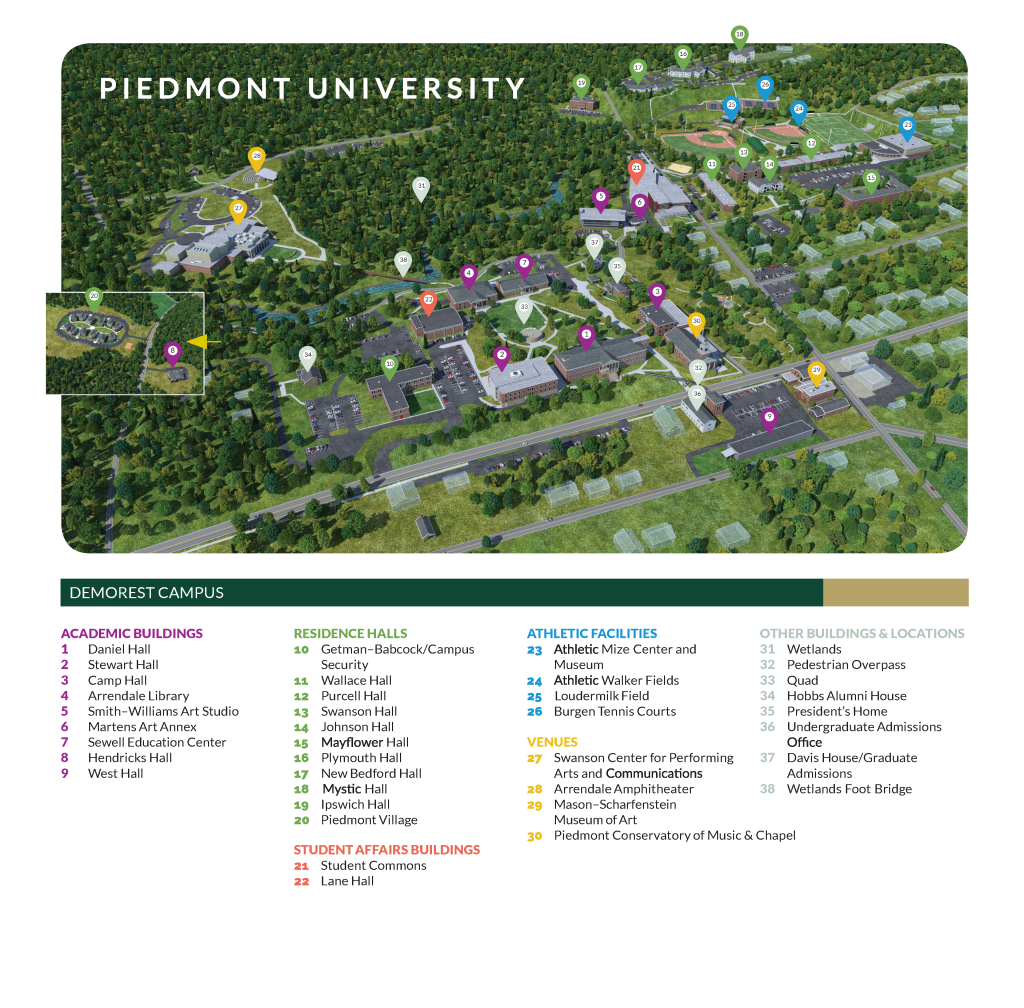
The Piedmont University campus map is below; workshops are expected to be either in Stewart Hall (#2) or the Campus Wetlands (#31).